Picasso’s Three Rebellions
People often spend a lifetime becoming what others expect. Some spend it becoming themselves. True greatness often begins in decisive acts of rebellion: leaving behind praise, prosperity, peace, and the obedient person one used to be.
Chapter One: Leaving Praise Behind for Paris
At thirteen, Picasso painted a pair of pigeon's feet so accomplished that his father handed over his own brushes and vowed never to paint again. He placed the family's hopes on the boy: his son would be the next Velázquez.
At fifteen, the technically flawless Science and Charity won acclaim at a national exhibition. Standing before the painting, the young prizewinner felt an emptiness: was this the summit of technique? Was there nothing ahead but repetition?
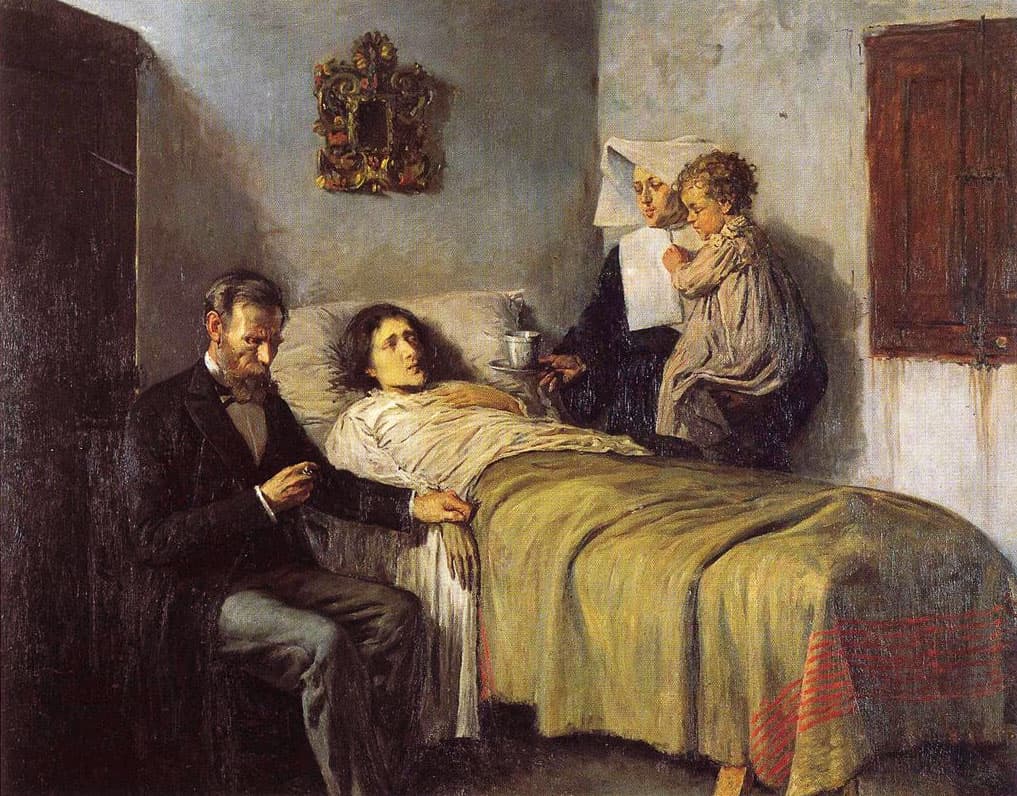
Science and Charity, 1897
At sixteen, his hopeful father sent him to Spain's foremost art school, the Royal Academy of Fine Arts of San Fernando in Madrid.
He already understood classical perspective, anatomy, light, and shadow. While his classmates practiced drawing, the professors' sacred rules felt like dust in a tomb. Photography was advancing. If perfect realism merely did a camera's work, what was painting for?
He began skipping classes, wandering through streets, brothels, and the Prado.
In Barcelona, the Four Cats café brought together avant-garde artists, anarchists, and struggling writers. There he encountered Nietzsche, Symbolist poetry, and modern art from northern Europe. Art did not have to imitate obediently. It could be a carnival of ideas.
When his father learned that he had left school, mixed with disreputable people, and begun painting strange, distorted figures, he was furious. Bitter arguments followed. Financial support stopped; their relationship froze.
But the question remained: painting had to express what a machine could not capture—unconscious life, emotion, the nature of things hidden from sight.
Madrid and Barcelona could no longer contain him. The art world had one center: Paris.
At nineteen, with a painting selected for the world's fair, he boarded a train for the city.
This was no holiday. It was a break with the life his father had planned, the language of academic painting, and the success within reach in Spain. He was heading somewhere foreign, fiercely competitive, and linguistically unfamiliar.
His early days in Paris were destitute. He spoke no French, had no dealer, and could not sell his paintings. Unable to buy coal, he burned stacks of drawings to keep warm.
He wandered Montmartre, cheap taverns, and brothels among people on society's margins: beggars, blind men, hungry mothers, and women drinking to endure their lives. His close friend Casagemas, who had traveled with him, took his own life in a café. The loss shattered him.
Poverty, cold, solitude abroad, and his friend's death pulled him into darkness. One color came to dominate his palette: a cold blue associated with despair and death.
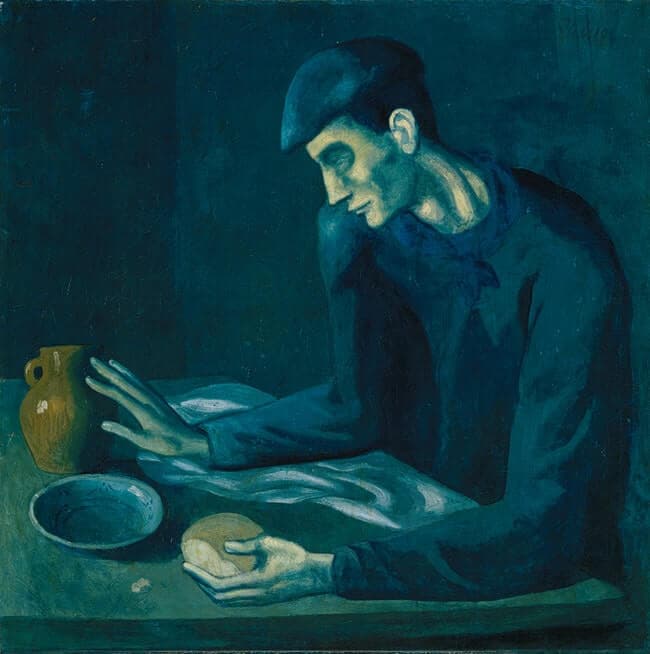
The Blind Man's Meal, 1903
Through hunger, cold, and an encounter with death, the academic prodigy fell away. In his place emerged someone searching suffering from within.
He came to understand painting as more than technique: it could reveal authentic feeling and the truth of a life.
Chapter Two: Leaving Prosperity Behind to Begin Again
At twenty-four, Picasso found his paintings becoming attractive and easy to sell. The discovery filled him with unease and boredom.
He would not become an ornament for middle-class living rooms. The gentle, agreeable Picasso of the Rose Period had to go.
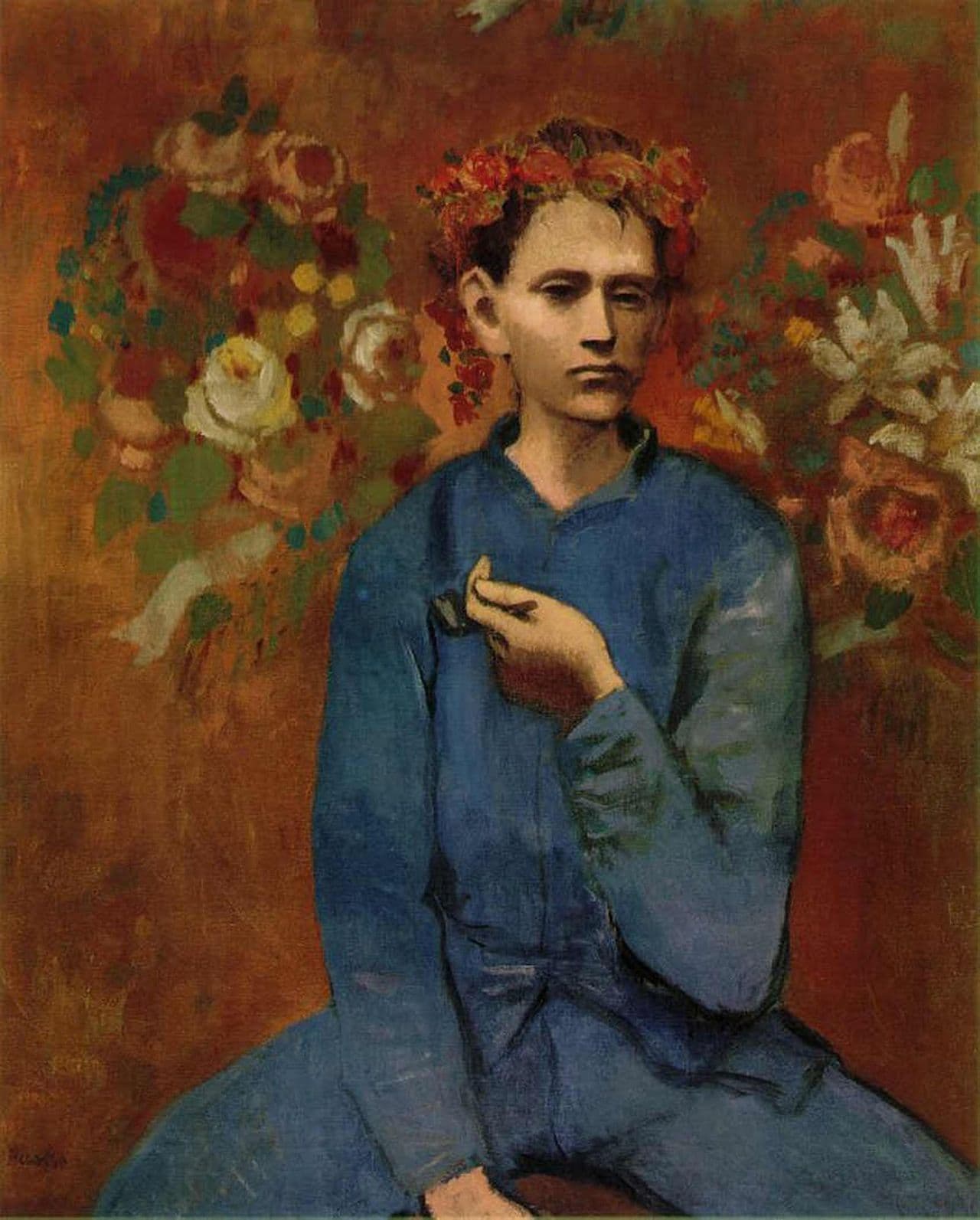
Boy with a Pipe, 1905
At twenty-five, seeking a more powerful spark, he returned to the remote Spanish village of Gósol. Ancient Iberian sculptures offered rough geometric forms rather than delicate features. He studied Cézanne. His painting became harder, solid as carved wood.
Back in Paris, he entered the Trocadéro ethnographic museum and encountered wooden masks taken from Africa. Something shook him deeply.
Art need not exist merely to please the eye. It could be a kind of magic: a means of confronting fear, the unknown, and death. A mask could summon a power beyond its maker.
He decided to paint a forceful work capable of piercing the polite façade of European civilization.
At twenty-six, he shut himself in his Montmartre studio, turning away visitors and even close friends. He worked alone for nearly a year.
The subject was five nude women in a brothel on Barcelona's Avinyó Street. Space became flat and sharp as broken glass. Bodies fractured into geometric shapes. The two faces on the right took on the severity of African masks. The women looked straight at the viewer without modesty, their gaze confrontational.
There was no conventional perspective or shading, none of the visual language European painting had prized since the Renaissance.
When friends first saw it, they reacted with shock, bewilderment, and even disgust. Braque compared the experience to being forced to eat tow and drink kerosene to spit fire.
Picasso broke centuries of rules, not because he had failed to learn them, but because he felt they could no longer hold the world he saw or the turbulence of a person standing at the threshold of the twentieth century.
He put the painting away in a corner for years. Yet for him, something in the old history of art had ended.
A revolutionary must first break apart the self before breaking apart the world.
Picasso challenged not only other people's definition of beauty, but his own last dependence on being correct.
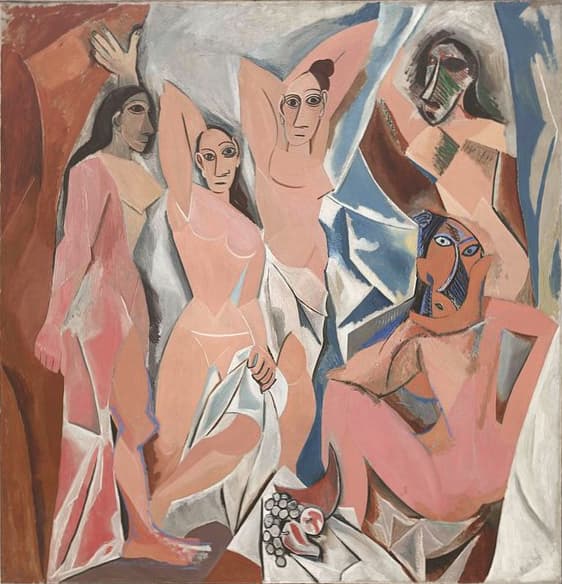
Les Demoiselles d'Avignon, 1907
The painting helped bring Cubism into being. It changed painting, sculpture, architecture, and design, changing how the twentieth century looked at the world.
At its beginning was a person's decision to remain faithful to his own eyes, even when everyone else said he had seen incorrectly.
Chapter Three: Leaving Peace Behind for Something Greater
In the years before he turned fifty-six, Picasso lived as though trapped in the labyrinth of his own desires. At the height of his artistic power, his inner life remained troubled.
Then came 1937.
In April, Nazi German aircraft supporting Franco bombed the largely undefended town of Guernica in northern Spain for more than three hours.
The town burned. Civilians died. When the reports and stark black-and-white photographs reached Picasso, he felt a pain beyond his personal joys and sorrows. To possess such gifts and fame yet devote them only to desire, anger, and private suffering suddenly seemed intolerable.
He awoke to the thought that continuing to dwell in private entanglements while violence ravaged civilization would betray life itself. His self-absorption gave way to fury on behalf of innocent people who had died.
He discarded the earlier sketches for his contribution to the Paris world's fair.
In a little over a month, he poured that fury onto a canvas almost eight meters wide and three and a half meters high.
He stripped away color: no red blood, no blue sky, only oppressive black, white, and gray. Before such death, decorative color seemed false. The painting would be as stark as an enormous newspaper, fixing the crime before the world's eyes.
The fractured forms of Cubism became a language for devastation: a severed arm, a woman raising a lamp, a mother crying out with her dead child. Distorted lines exposed the terror of people confronted by violence.
The painting was Guernica. Its appearance struck the world with extraordinary force.
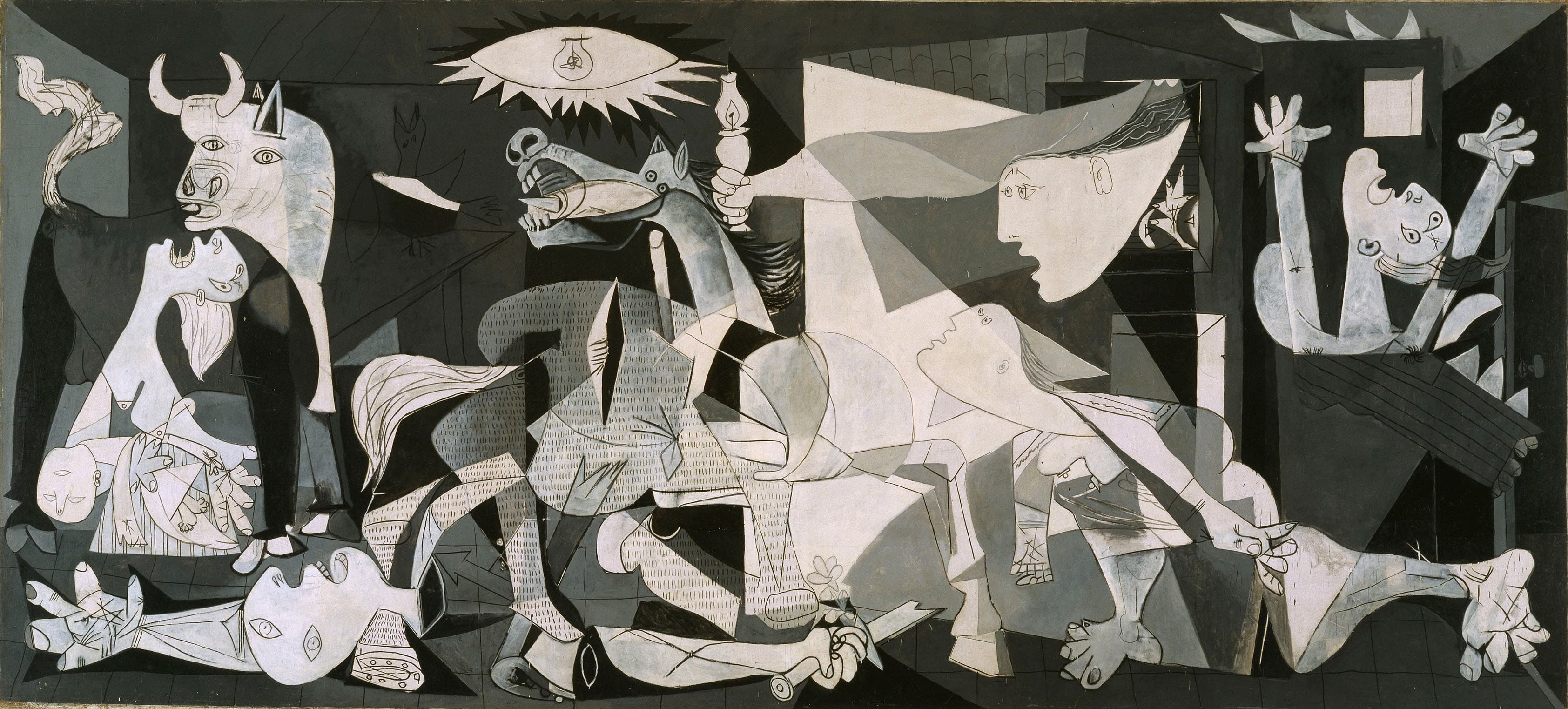
Guernica, 1937
A story tells of a Gestapo officer searching Picasso's studio during the Second World War and noticing a reproduction of the painting.
Pointing at the image, the officer asked whether Picasso had made it.
Picasso's reply, in the story, was cold and contemptuous.
No. It was their work.
When bombs and violence sought to silence Europe, he turned anger into purpose and artistic skill into a flag against war. The audacity that had once belonged to him alone became a cry on behalf of others.
A canvas could become more than pigment and linen: an enduring image of resistance to fascism and a call for peace.
Epilogue
Picasso broke apart his own life three times.
First, the future his father had drawn for him. Then, the gifted beauty that had brought him success. Finally, the shell of private indulgence surrounding the celebrated artist.
Each rebellion brought him closer to a life of his own.
We often imagine becoming ourselves as a quiet inward search.
Picasso's story suggests that it can also mean risking a break with familiarity, comfort, applause, and power—and living one's life with courage and conviction.