Beethoven: Music from the Depths of Silence
Sometimes fate does not answer at once. It simply lets the familiar things around us fall away.
Applause recedes, heroes fall, and even the most ordinary sounds gradually disappear.
Only when everything grows quiet does the voice that has never left us become clear.
Where Sound Ends
Vienna in the 1790s. Prince Lichnowsky's residence glowed with light.
Chandeliers scattered candlelight across silver cups, medals, and jewels. Princes, counts, and patrons gathered around the piano, studying the young man from Bonn who had entered their world.
Beethoven lowered his head, unruly dark hair falling forward. His fingers paused. A simple theme plunged into the bass, the melody darkening; then his right hand flashed across the keys, bright notes flying like sparks. The rhythm accelerated, shifted, and changed shape.
Conversations faded. Women stopped moving their fans. Men set their wineglasses down. Even the servants slowed at the door.
Beethoven seemed unaware. He leaned toward the instrument, frowning, throwing his weight into the keys until the sound rushed like a storm over a roof. Then he drew back, leaving a few soft notes suspended in the silence. The room tightened and held its breath. A moment later, a chord broke like thunder. The strings were still vibrating when he lifted his head.
For a moment, nothing moved. Then applause erupted.
This young man had neither a title nor a distinguished name. With ten fingers, he had made people accustomed to being admired look toward him.
He inhabited that pride. At the piano, he did not need to explain who he was.
Heiligenstadt, 1802.
Thirty-one-year-old Beethoven sat alone at a table late at night. The countryside outside had gone dark. A candle moved in the stillness.
Everything he could hide by day behind anger, coldness, or arrogance became unavoidable in solitude. Just as Vienna began to hear Beethoven, his own world was losing its sound.
He remembered standing among people, unable to follow their words, reading their lips and expressions to guess their meaning. Worse, he could not bring himself to admit it. He let others believe him solitary, rude, and unapproachable.
Why his ears? Fear, shame, and anger rose together. He had trusted his will, believing nothing could defeat him. Only a year earlier, he had written of seizing fate by the throat. Now fate seemed to be taking away the very thing through which he knew himself.
He took up his pen. His anguish became the document known as the Heiligenstadt Testament, addressed to those who thought him hostile, stubborn, or misanthropic and did not understand him.
He wrote that he had come close to ending his life.
At that point, applause, fame, even the identity of the brilliant pianist lost their weight. If his life ended now, what would remain unfinished?
Only art, he wrote, had held him back.
There were works still to be made, sounds that existed within him and had not yet entered the world.
He felt he could not leave before bringing into being what he believed himself capable of creating.
That night he did not conquer fate. He began to discover what he lived for when outward proof no longer mattered.
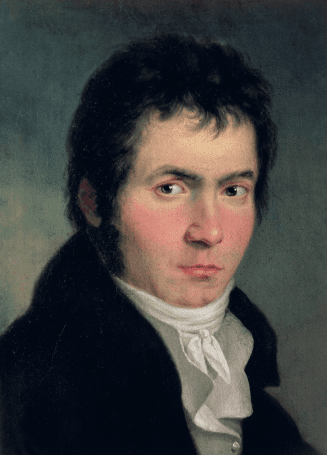
1804
A Funeral for the Hero
Vienna, 1804.
Thirty-three-year-old Beethoven opened the title page of his Third Symphony and stared at the name he had written with such care: Bonaparte.
Then he crossed it out. The ink was scraped away, the paper's fibers torn, until the name was nearly unreadable and the page was damaged.
A few years earlier, the name had filled him with hope.
The French Revolution had shaken centuries of hierarchy. A young officer without an exalted background had risen through ability, courage, and will. Napoleon seemed to show that birth need not determine one's place, that a person could change the direction of a life through their own force.
Then came the news: Napoleon had declared himself emperor. The man who had broken through the old order was placing himself above everyone else.
Beethoven had admired the possibility that human worth needed no crown. Now his hero had put one on.
As that outward ideal broke apart, another conviction took shape: a belief need not wait for someone else to prove it. It must be answered with one's own life.
Bonaparte's name disappeared. The Eroica found its voice.
At first, the music moves forward with expansive strength, like a person crossing the world with their whole will.
In the second movement, the light changes.
Low voices establish a heavy step. Violins begin a lament. A funeral march advances. No triumph, no crown: the hero appears to have fallen, leaving a procession through long, dark streets.
Grief rises and sinks again. Glory will disappear. Names will disappear. Even the person everyone once looked up to must eventually be carried into darkness.
But the music continues. The procession moves on.
Perhaps the funeral buries more than a hero's name. Perhaps it also buries the part of Beethoven that still needed someone outside himself to supply the answer.
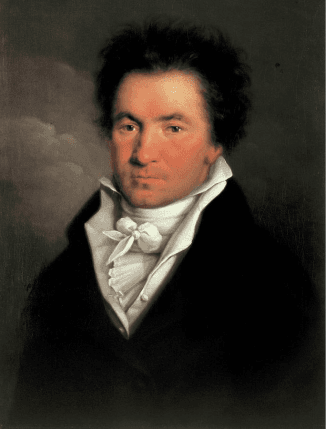
1815
Be Embraced, All of You
In his later years, Beethoven lived in near-total silence.
The young man who had held Vienna spellbound at the piano had not performed publicly for years. Yet he was not forgotten. As his hearing deteriorated, visitors wrote their side of conversations in notebooks. Voices seemed to stop at an invisible wall.
The candle on his desk moved. Outside were wind in trees and carriage wheels on stone, sounds that no longer reached him. He bent over densely written scores, revising, pausing, closing his eyes to seek the next sound. The melodies seemed to rise from within rather than arrive through his ears.
This time, the music's central figure was not a named hero, but people calling to one another and singing together. More than standing above others, he believed in a dignity, freedom, and creative power that birth, rank, and fate could not erase. That belief entered the music one voice at a time: strings preparing a melody, brass opening the space, the human voice finding its moment like someone speaking for the first time after a long night.
The world had taken sound away. Through music, he made another world.
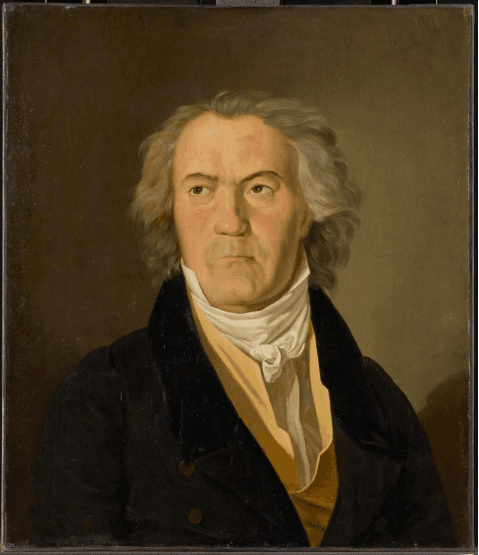
1823
May 7, 1824. Vienna.
At fifty-three, Beethoven stood before an audience again.
The theater shone. Boxes rose in tiers, crowded with fine clothes, uniforms, jewels, and expectant faces. Musicians filled the stage. Bows touched strings; brass caught the light.
The Ninth Symphony began. Its first three movements carried the room through a long night: power emerged from turbulence, rhythm sharpened, and the music surged forward before falling back into shadow. In the third movement, the storm eased. Strings opened into a broad stillness.
The hall seemed suspended within an unfinished breath.
Then the final movement began. Earlier darkness returned briefly and withdrew. From below, a plain melody rose like a seed breaking the earth, like the first light at winter's end. One voice took it up, then another. It broadened through the orchestra.
Then, for the first time in a Beethoven symphony, human voices entered.
A solo voice began. Others followed, passing beyond strings and brass. What belonged to one voice passed into several, then into the chorus, until the stage seemed to breathe as one.
“Be embraced, you millions!”
Joy no longer belonged to one person. It crossed the divisions between people and spread from the stage into the theater. Darkness, conflict, and solitude had not become life's final word. What remained was joy, an embrace, a life opening toward others. In a shared sound, birth, status, and fate no longer kept people apart.
Beethoven stood at the center of the stage, within the music he had made. Before him was an audience in an uproar.
His own world was silent.
Epilogue
Silence surrounded Beethoven, but did not seal him off.
The sounds that could no longer reach him from outside gathered within, passed through paper and instruments, and became the song of many voices.
A year later, recovering from a serious illness, he gave a movement of a string quartet the title Holy Song of Thanksgiving of a Convalescent to the Deity.
The music flows slowly. Elsewhere in the movement appears another instruction: “Feeling new strength.”
When applause recedes, heroes fall, and the world goes quiet, a person may still wish to create, still wish to affirm life.
In silence, he heard himself. That sound reached beyond him toward everyone.